CDA Training Unit 1
  • Unit 1 Home Page
    • About Us
    • About the Trainers
    • Blog
    • CDA Credentialing Process
    • CDA Success Stories
    • Course Synopsis
    • Technical Requirements
    • Terms of Use
    • What is a CDA?
  • Enroll Now
    • Washington STARS
  • Student Log-In
  • Contact
  • CDA Virtual Classroom
    • Unit 1
    • Unit 2
    • Unit 3
    • Unit 4
    • Unit 5
    • Unit 6
    • Unit 7
    • Unit 8
Sentry Page Protection
Please Wait...
MyCdaClass.com Student Login  CDA Virtual Classroom Student Login     Hi, (First Name) Member Area | Log Out
Student Login
Welcome, (First Name)!

Forgot? Show
Log In
Enter Member Area
(Message automatically replaces this text)
OK
My Profile Log Out

(Unit 1) Topic 5: Environmental Safety

Choking, Strangulation and Suffocation

​Topic 5 Page 13

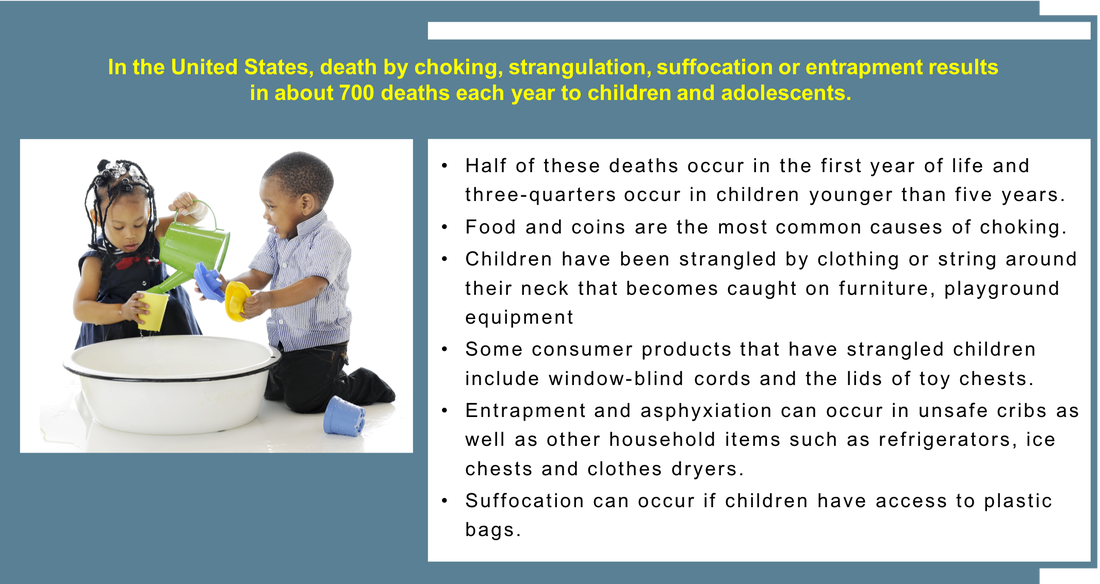
Young children in their first three years of life are at greater risk of choking and suffocation. They may choke during meals or during playtime because they use their mouths to explore and experiment with unfamiliar objects. Some situations that are likely to lead to choking on food include eating while rushed, running and laughing.
Picture
​Choking and suffocation are frightening because they occur suddenly. Only six minutes without oxygen can cause brain damage in children. The signs of choking and suffocation in children are difficulty speaking or breathing, the inability to cough, wheezing sounds, clutching of throat or gesturing, a bluish face, confusion and unexplained loss of consciousness (this is a very late sign). 
You can take the following steps to reduce the risk of mechanical airway obstruction:
  • Learn the proper response and techniques for helping choking or suffocating infants and children.
  • Foods that are round, hard, small, thick, sticky, smooth or slippery should not be offered to children younger than four years of age. For infants, foods should be cut in small pieces no longer than 1/4" cubes; for toddlers, pieces no longer than 1/2" cubes. Children should not be allowed to eat while walking, running, playing, lying down or riding in a vehicle.
  • Objects smaller than 1 1/4" in diameter should not be accessible to children who put things in their mouths.
  • Check toys and equipment regularly for small parts that may break off, such as eyes and noses on stuffed animals, buttons on doll clothes or plastic hats or shoes on miniature people. Remove or securely attach these items.
  • Plastic bags, pins, nails and toothpicks should not be accessible to children younger than four years.
  • Never use old cribs with bars more than 2 3/8" apart. Never place a crib near window blinds. Take down hanging toys from across the crib. To prevent a child from suffocation, there should be no more than two fingers in width between the side of the crib and the mattress.
  • Secure or shorten window blind cords.
  • Be aware of the needs and protections for children with developmental delays, swallowing or other disabilities.

Possible Choking and Suffocation Hazards
Toys
  • Balloons
  • Game pieces
  • Game tokens
  • ​Jacks
  • Marbles
  • Plastic bags
  • Play jewelry
  • Small objects
  • Small toys (less than 1 1/2")
  • Toy chests with no air holes
Foods
  • Big chunks of meat
  • Whole grapes and raisins
  • Gum
  • Hard candy and cough drops
  • Hot dogs and sausages cut in rounds
  • Lollipops
  • Whole olives
  • Peanuts, nuts
  • Popcorn
  • Raw vegetables (carrots, etc.)
  • Watermelon seeds
  • Spoonfuls of peanut butter
  • Dried fruit
Objects
  • Pins and nails
  • Toothpicks
  • Pencils and pens
  • Crayons
  • Staples
  • Coins
  • Jewelry
Picture
Picture
(Unit 1) Topic 5: Environmental Safety * Navigation Menu
Picture
Picture
Picture
Picture
Picture
Picture
Picture
Picture
Picture
Picture
Picture
Picture
Picture
Picture
Picture
Picture
Picture
Picture
Picture
Picture
Picture
Picture
Picture
Picture
Picture

Successful Solutions Training in Child Development

Address: PO Box 727, Burley, WA 98322-0727  * www.mycdaclass.com
Copyright 2018.  Successful Solutions Professional Development LLC.  
All Rights Reserved. Updated May 8, 2018

Successful Solutions Professional Development LLC BBB Business Review
Picture

Enrollment Hours

Monday - Friday          7  am – 8  pm 
Saturday & Sunday     9  am – 8  pm
Holidays                       9  am – 8  pm

Telephone

(360) 602-0960 

Email

[email protected]
  • Terms of Use for Online Courses
Registrations that are submitted after enrollment hours will be processed the next morning.  You will receive an email with your log-in information to access the course within an hour after we open the next business day.
  • Unit 1 Home Page
    • About Us
    • About the Trainers
    • Blog
    • CDA Credentialing Process
    • CDA Success Stories
    • Course Synopsis
    • Technical Requirements
    • Terms of Use
    • What is a CDA?
  • Enroll Now
    • Washington STARS
  • Student Log-In
  • Contact
  • CDA Virtual Classroom
    • Unit 1
    • Unit 2
    • Unit 3
    • Unit 4
    • Unit 5
    • Unit 6
    • Unit 7
    • Unit 8